Pregnant Moms- research.
Maternal Health Warning: SSRIs and Fetal Brain Development
Dr. Adam Urato, MD – Metrowest Medical Center
No disclosures.
I care for my patients as if they are my neighbors—offering compassionate care while weighing risks and benefits.
More and more, pregnant women are not being fully informed about the potential risks of SSRI (Selective Serotonin Reuptake Inhibitor) use during pregnancy.
“We must give women the full truth—SSRIs cross the placenta and can affect the developing fetal brain.”
Critical Gaps in Informed Consent:
Many are told SSRIs don’t affect the baby.
But there are no warning labels clearly stating that SSRIs may alter fetal brain development.
Research shows:
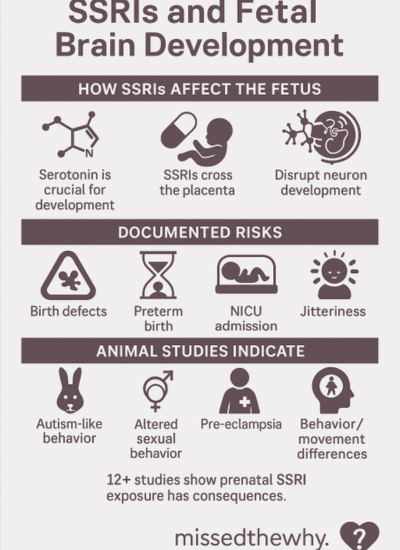
- Serotonin plays a crucial role in fetal brain development.
- SSRIs disrupt the serotonin system.
- SSRIs cross the placenta and can interfere with fetal development.
What the Research Shows:
- SSRIs impact the development of individual neurons in the fetal brain.
- Animal studies (mice, rabbits, sheep) show autism-like behaviors, altered social and sexual behaviors.
- Associated with birth defects, preterm delivery, and postpartum hemorrhage.
Observable Effects:
- Drugs that alter the mother’s brain may also alter the baby’s.
- Changes are visible in ultrasounds.
- After birth, affected newborns may experience:
- Jitteriness
- Breathing difficulties
- Increased admissions to NICU
Supporting Evidence:
- At least 12 peer-reviewed studies confirm the risks of prenatal SSRI exposure.
- Long-term effects may include:
- Birth defects
- Miscarriage
- Pre-eclampsia
- Altered brain development
- Atypical movement and behavioral patterns
-
Fetal Brain Development & Serotonin Disruption
SSRIs and the Developing Brain
PMC (2014) – Serotonin disruption in utero
Reviews how SSRIs cross the placenta and alter fetal brain development via serotonin system interference.
Prenatal SSRI exposure and fetal head growth
JAMA Psychiatry (2016)
Demonstrates reduced fetal head growth associated with maternal SSRI use.
Antidepressants in pregnancy and fetal brain morphology
Nature Communications (2025)
Reveals long-term alterations in brain circuitry and emotion regulation.
Does prenatal SSRI exposure alter infant brain structure?
CUIMC – Columbia University (2020)
MRI shows amygdala/insula volume changes in exposed infants.
White matter microstructure after prenatal antidepressant exposure
Women’s Mental Health Blog – MGH (2023)
White matter differences in children exposed to SSRIs in utero.
Neonatal Adaptation Syndrome & Short-Term Outcomes
Antenatal Antidepressants and Neonatal Outcomes
PMC (2016)
Links SSRIs to respiratory distress, jitteriness, and NICU admission.
Risk of poor neonatal adaptation with SSRIs
Pediatrics UCSF (2023)
Population study showing elevated NICU risk with late-pregnancy SSRI use.
Dose-related neonatal symptoms following SSRI exposure
Nature Pediatric Research (2017)
10–30% incidence of transient symptoms depending on dose and timing.
Prenatal fluoxetine exposure and NICU admission
JAMA Pediatrics
Fluoxetine associated with preterm birth and NICU admission.
Neonatal outcomes with late-trimester SSRI use
American Journal of Obstetrics and Gynecology
Shortened gestation and longer neonatal stays.
Birth Defects, Preterm Birth, and Maternal Risks
SSRI use and congenital cardiac defects
BMJ (2009)
First-trimester paroxetine and fluoxetine linked to septal heart defects.
SSRI exposure and preterm birth
American Journal of Psychiatry (2006)
Higher incidence of early delivery in SSRI users.
Risk of pre-eclampsia with antidepressants
Women’s Mental Health Blog – MGH
Modest increase in hypertensive disorders during pregnancy.
SSRIs and persistent pulmonary hypertension (PPHN)
NEJM (2006)
Elevated risk of PPHN among SSRI-exposed newborns.
Animal Studies: Mechanistic & Behavioral Insights
Prenatal SSRIs alter rodent social/sexual behavior
Frontiers in Behavioral Neuroscience (2011)
Animal models show SSRI exposure induces lasting behavioral changes.
Rodent evidence of SSRI-induced neurodevelopmental disruption
International Journal of Developmental Neuroscience
Prenatal exposure causes neuronal migration and serotonin abnormalities.
Lifelong emotional dysregulation from SSRI exposure
Child and Adolescent Psychiatry and Mental Health (2023)
Anxiety and depressive-like behaviors in SSRI-exposed rodents.
Reviews & Meta-Analyses
Review: Antidepressants and pregnancy risks
Harvard Review of Psychiatry (2011)
Comprehensive overview of fetal and maternal effects.
Meta-analysis: Neonatal and birth risks from SSRIs
Canadian Paediatric Society (2020)
Summary of neonatal withdrawal and persistent effects.
Long-term outcomes of prenatal antidepressant exposure
CNS Drugs (2013)
